Overview
Global change has triggered a number of environmental changes, such as alterations in climate, land productivity, water resources, atmospheric chemistry, and ecological systems. Finding solutions to the impact of global change is one of the most important challenges of the 21st century.
TERENO is embarking on new paths with an interdisciplinary and long-term research programme involving six Helmholtz Association Centers. TERENO spans an Earth observation network across Germany that extends from the North German lowlands to the Bavarian Alps. This unique large-scale project aims to catalogue the longterm ecological, social and economic impact of global change at regional level. Scientists and researchers want to use their findings to show how humankind can best respond to these changes.
Our Vision
Through combining long-term Earth system observations and modelling, TERENO discovers how terrestrial socio-ecosystems function under a changing environment and provides guidance to manage their sustainability.
Our Mission
Development and ongoing improvement of a unique interdisciplinary German research infrastructure that provides high quality observation data to scientific leaders, researchers, stakeholders, and decision makers, to prepare society for a better future. We also use this infrastructure to educate and train the next generation of leaders and Earth-system scientists.
What is TERENO?
The Terrestrial Environmental Observatories Network (TERENO) is a long-term operated research network of four established, long-term groundwater-soil-vegetation-atmosphere observatories to study complex interactions and feedbacks within terrestrial ecosystems.
|
Terrestrial Environmental Observatories
|
|
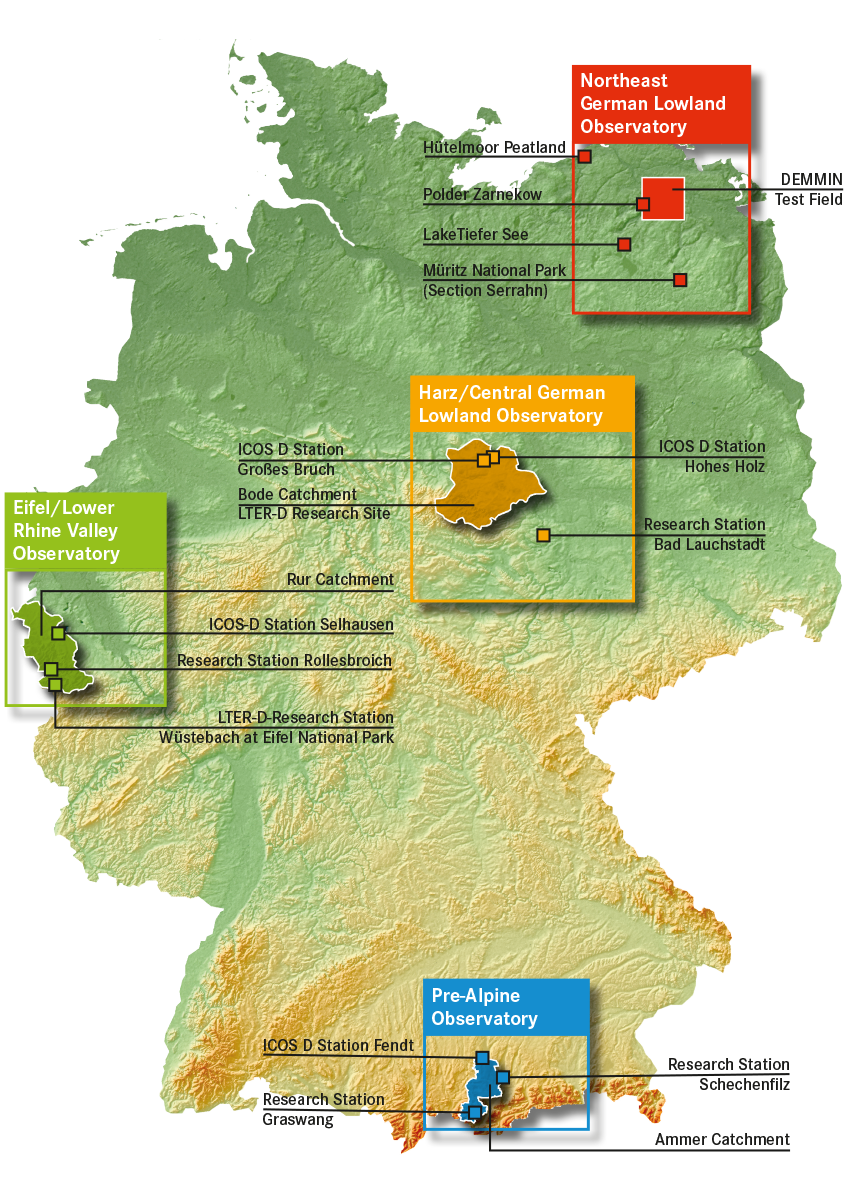 |
Northeast German Lowland Observatory
Harz / Central German Lowland Observatory
Eifel / Lower Rhine Valley Observatory
|