Tuesday Sessions 26.09.2023
Keynotes
Dörthe Tetzlaff, Humboldt Universität zu Berlin
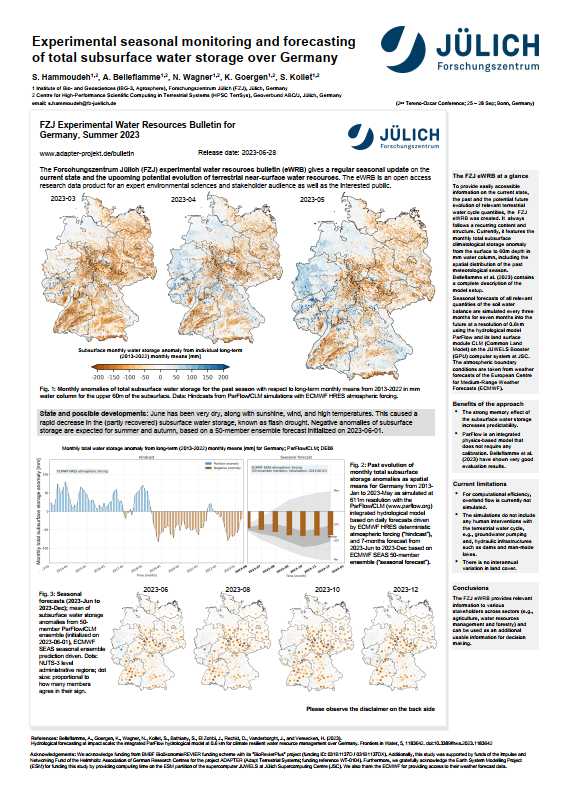
Enhancing monitoring and modelling of water storage dynamics
Kevin Bishop, Swedish University of Agricultural Sciences (SLU), Uppsala
The complementary power of extensive environmental monitoring programs and intensively instrumented observatories for supporting the “green transition” to Agenda 2030
Marie-Elodie Perga, University Lausanne
Building upon multiple-scale observatories to delineate the sources and mechanisms of CO2 emissions from lakes
Daniela Vanella, Università degli Studi di Catania
Electrical resistivity applications for supporting precision agriculture: a promising approach also for environmental monitoring?
Session: Innovative sensing and analysis methods for environmental research
Sonia Akter, Forschungszentrum Jülich GmbH
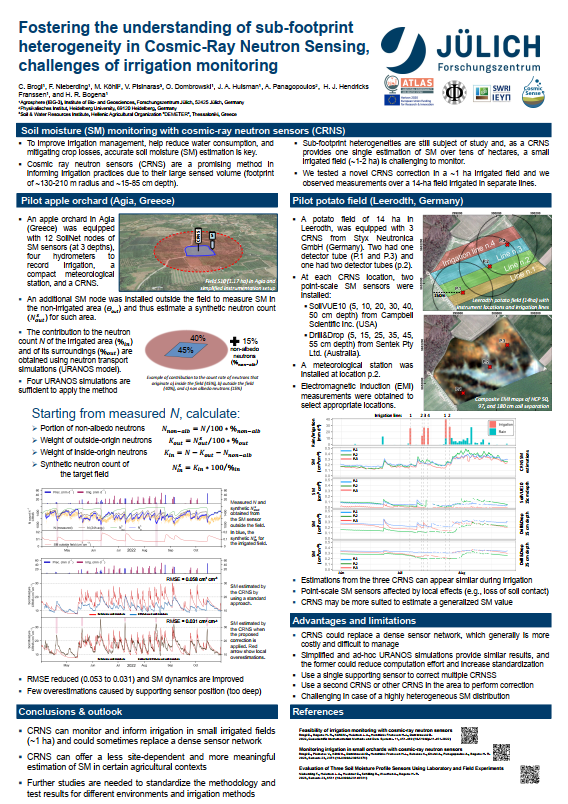
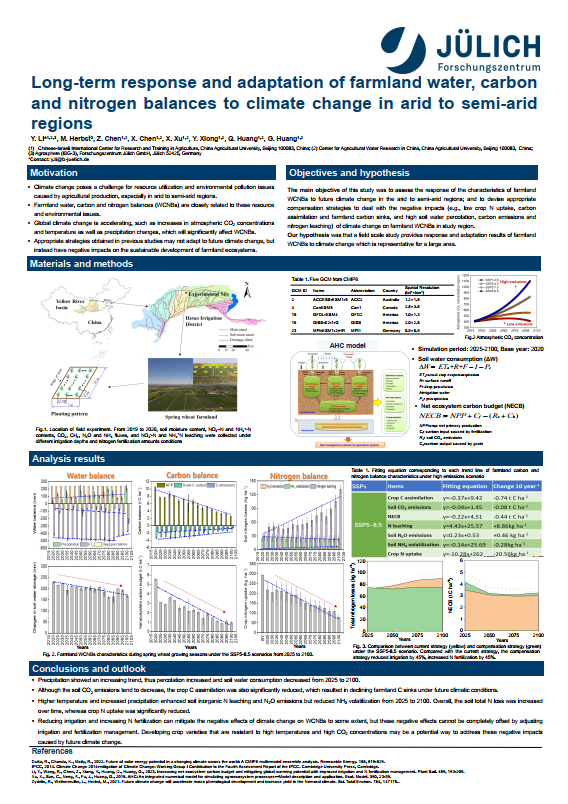
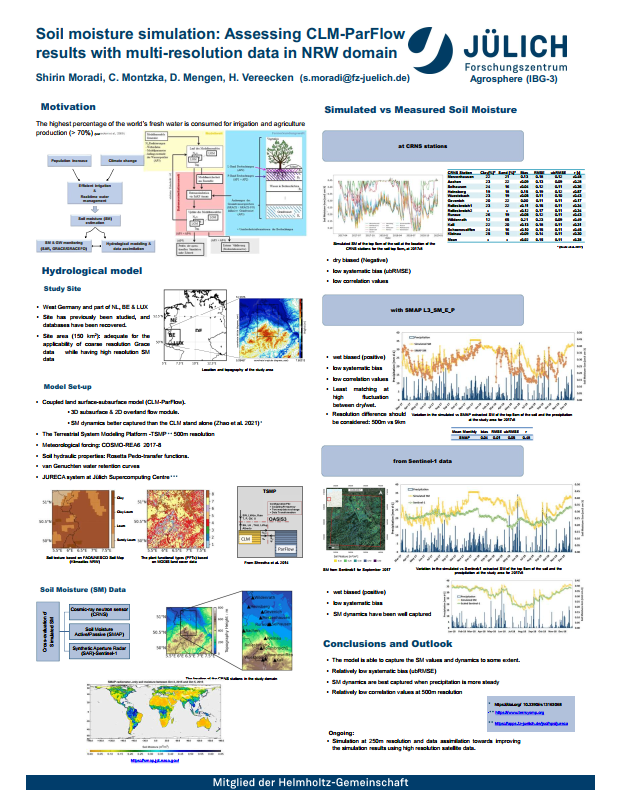
Assessing the accuracy of root-zone soil moisture prediction from gamma radiation monitoring data
Nurit Agam, Ben-Gurion University of the Negev
Water dynamics in dry soils – using relative humidity sensors to measure water vapor adsorption in desert soils
Martin Schrön, UFZ - Helmholtz Centre for Environmental Research GmbH
Spatiotemporal soil moisture monitoring with cosmic rays in TERENO, Central Germany
Luca Stevanato, Finapp srl
Self-referenced Cosmic Rays Neutron Sensing probes based on contextual muons detection
Patrick Davies, KNUST
Optimal Temporal Filtering of the Cosmic-Ray Neutron Signal to Reduce Soil Moisture Uncertainty
Francis E. Oussou, Federal University of Technology Akure
Improving the depth-to-bedrock maps for groundwater-to-atmosphere modeling in Africa
Daniel Schulz, Forschungszentrum Jülich GmbH
Plant functional type-specific and temporally resolved evapotranspiration partitioning using water stable isotopologues
Inge Wiekenkamp, GFZ German Center for Geosciences
Airborne eddy covariance for estimating regional turbulent matter and energy fluxes in NE Germany
Antoine Lucas, IPGP/CNRS
Mapping Critical Zone biomass and surface roughness with a backpack LiDAR
Ulrike Werban, UFZ - Helmholtz Centre for Environmental Research GmbH
Direct push-color sensing and geophysical mapping – a combined approach to investigate floodplain structures
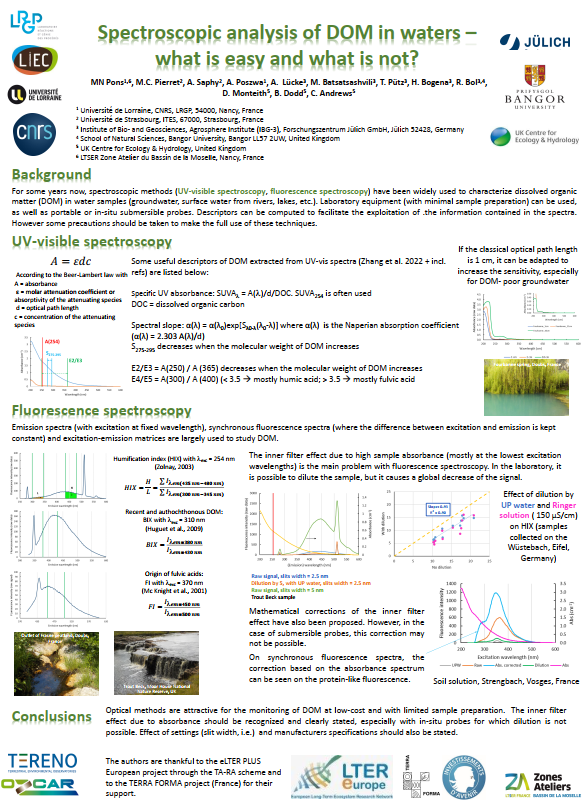
Marie-Noëlle Pons, Université de Lorraine
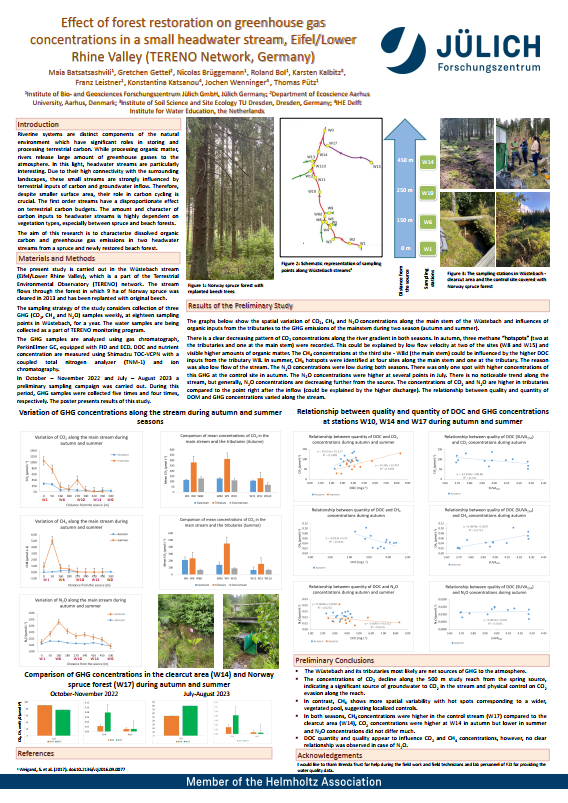
Effect of clear-cutting on the dissolved organic matter in the Wüstebach catchment
Christoff Andermann, Université Rennes
Automated high resolution water sampler
Session: Measuring and modelling water storage dynamics
Jayson Gabriel Pinza, University of Antwerp
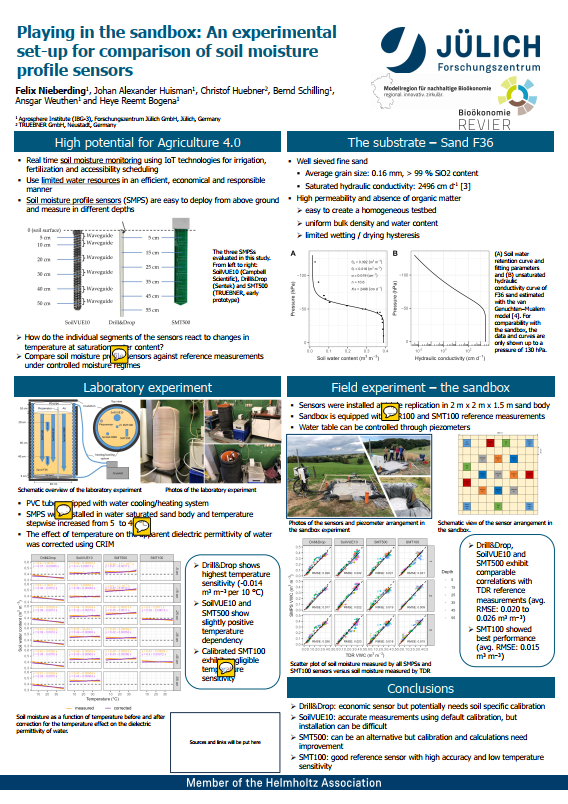
Sandy soil compaction and influence to hydrologic balance: insight from 1D soil water flow modeling of experimental setups
Jordy Salmon-Monviola, INRAE - Institut Agro, UMR SAS
Improving the internal hydrological consistency of a process-based solute transport model by simultaneous calibration of stream concentration and water flow
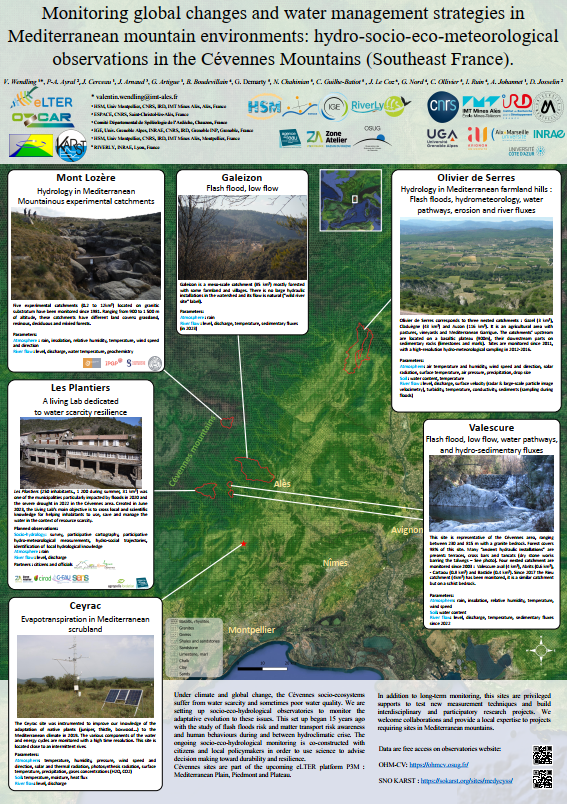
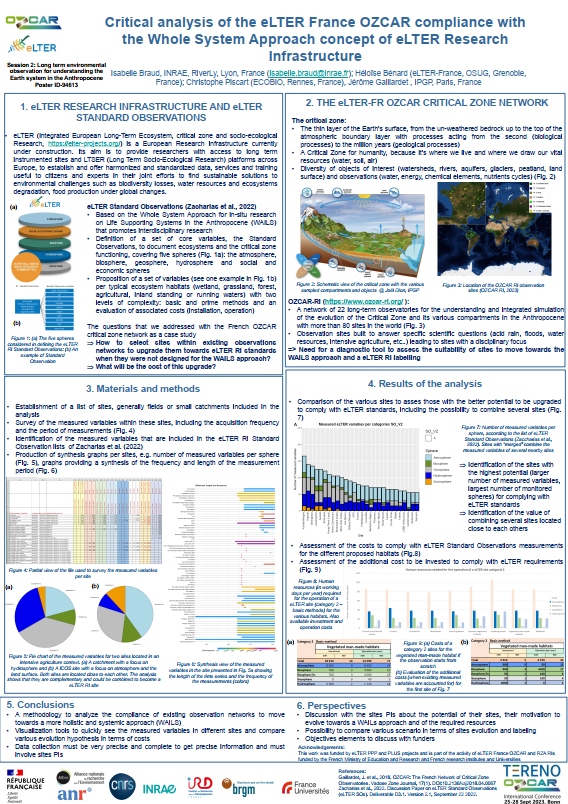
Julien Ackerer, IGE grenoble & OZCAR RI
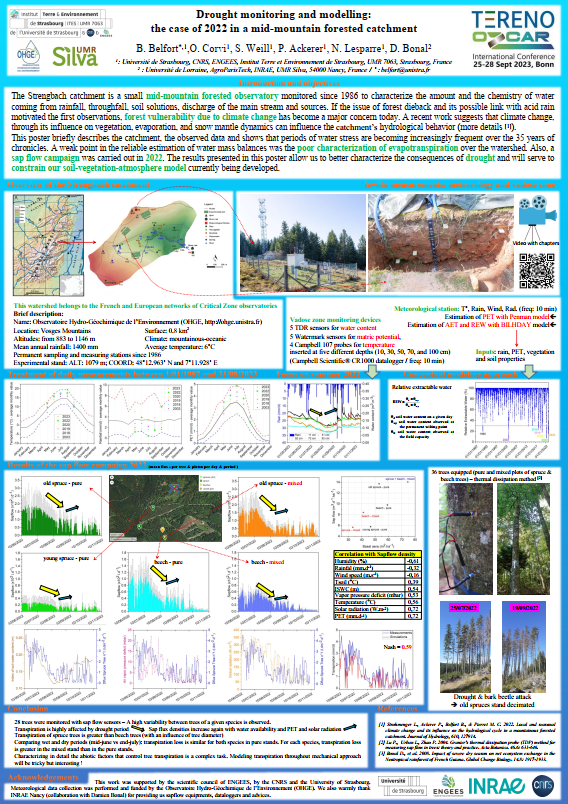
Integrated and ecohydrological modeling of the water cycle in three contrasting long term observatories (OZCAR network, France)
Aniket Gupta, University of Grenoble Alpes
Modeling global warming impacts on Rain/snow partitioning, water path, and residence time in a mid-elevation mountain catchment
Mathilde de Fleury, Université Toulouse
Hydrological regime of Sahelian small water bodies from combined Sentinel-2 MSI and Sentinel-3 SRAL data
Olga Dombrowski, Forschungszentrum Jülich GmbH
Assessing the impact of irrigation on water storage dynamics in a Mediterranean catchment using land surface modelling
Fabrice Rodriguez, Campus Nantes - Univ Gustave Eiffel
What happens to rainfall in urban areas? Dual monitoring and modelling approach in a small urban catchment in Nantes, France
Session: Long-term environmental observation for understanding the Earth system in the Anthropocene
Paolo Nasta, University of Naples
Exploring soil water dynamics in the Alento hydrological observatory
Xiao Lu, Forschungszentrum Jülich GmbH
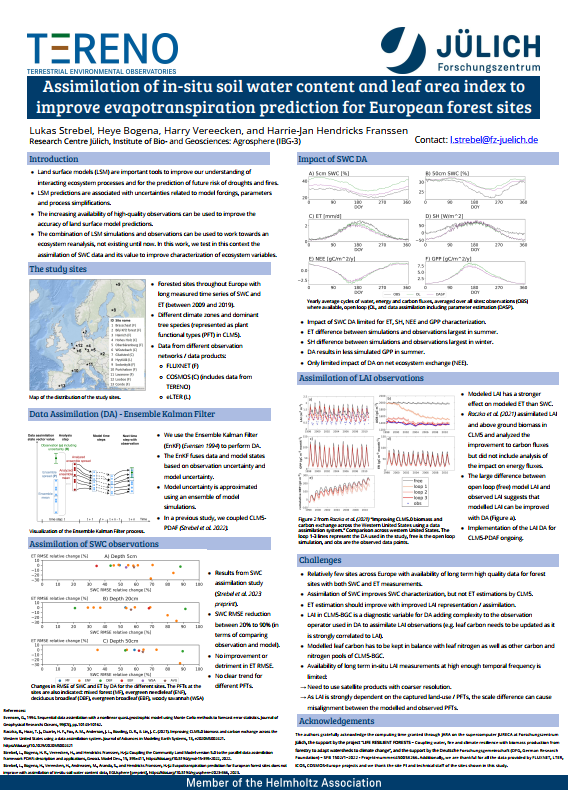
Analysis of Scale-dependent Spatial Correlations of Actual Evapotranspiration Measured by Lysimeters
Laura Nadolski, Max-Planck Institute for Biogeochemistry, Jena
Revealing Carbon Dynamics from Long-Term Observational Data in a Mediterranean Savanna Ecosystem with Different Fertilization Treatments
Jannis Groh, Forschungszentrum Jülich GmbH
Do we know our soil‘s water cycle well?
Gerhard Helle, GFZ German Center for Geosciences
Differentiated response of pine and oak to air quality changes and recent drought in rural Northeastern Germany
Wolfgang Korres, Federal Institute of Hydrology (BfG)
The International Soil Moisture Network (ISMN): Ensuring a permanent service for delivering long-term, in situ soil moisture data
Wednesday Sessions 27.09.2023
Keynotes
Cathy Hohenegger, Max Planck Institute for Meteorology, Hamburg
Representation of the water cycle and its coupling to the land surface in a kilometre-scale Earth System Model
Jantienne Baartman, Wageningen University
Modelling the dynamics of sediment and associated substances across temporal and spatial scales
Julian Klaus, University of Bonn
Groundwater-surface water interactions as driver for streamflow dynamics: Insights from an experimental headwater catchment
Daniella Rempe, University of Texas at Austin
Observing interactions between tree roots, minerals, and fluids in a shale critical zone and implications for weathering and landscape evolution
Session: Biogeochemical processes at the soil and catchment scale
Valentine Rollot, Université Paris Cité
Microbial biofilms structure and manganese (bio)cycling: from field to lab studies
David Uhlig, Freie Universität Berlin
Imbalances in dissolved elemental export fluxes disclose “hidden” Critical Zone pathways
Nicolaus van Zweel, Luxembourg Institute of Science and Technology
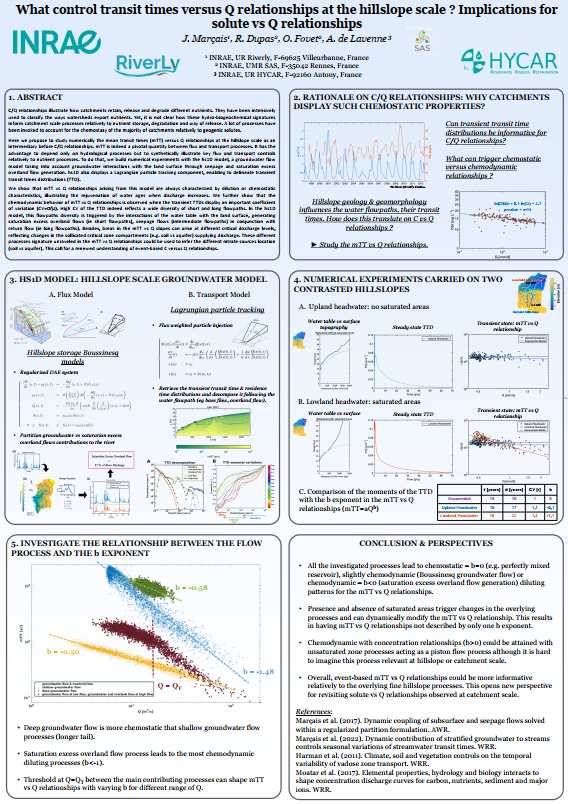
On previously unseen flowlines and their potential significance for understanding concentration-discharge patterns in headwater streams
Claudia Schütze, UFZ - Helmholtz Centre for Environmental Research GmbH
Temporal and spatial pattern of riverine greenhouse gas emissions in a large temperate river
Andreas Musolff, UFZ - Helmholtz Centre for Environmental Research GmbH
High-frequency concentration-discharge relationships of nitrate and dissolved organic carbon reveal altered nutrient mobilization during forest dieback
Qiqi Wang, Forschungszentrum Jülich GmbH
Deforestation alters dissolved organic carbon and sulphate dynamics in a mountainous headwater catchments-a wavelet analysis
Annemarie Bäthge, UFZ - Helmholtz Centre for Environmental Research GmbH
The influence of clear-cut on nutrient dynamics in the Wüstebach catchment (Eifel, Germany) – Preliminary results from a modelling study
Michael Rode, UFZ - Helmholtz Centre for Environmental Research GmbH
Disentangling in-stream nitrate uptake pathways based on two-station high-frequency monitoring in high-order streams
Rémi Dupas, INRAE - Institut Agro, UMR SAS
Nitrate and phosphorus export dynamics during the extreme storm events of the future
Session: Water and biogeochemical cycles in Earth system models
Yves Godderis, Geosciences Environnement Toulouse, GET, CNRS, UMR5563
The role of the thickness of the regolith cover on the Earth climate stability
Filip Kiałka, Ecole Normale Supérieure & CNRS
Composite models of soil hydraulic properties for representing soil (de)compaction in land surface models
Liubov Poshyvailo-Strube, Forschungszentrum Jülich GmbH
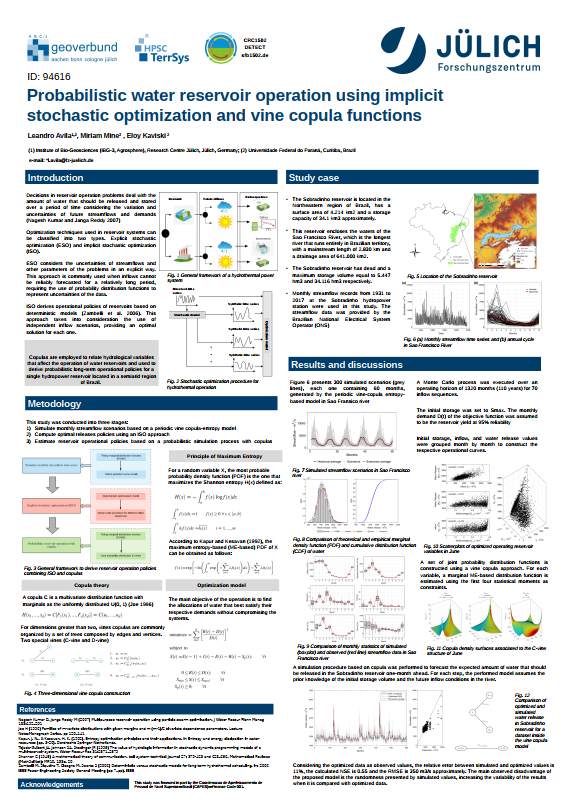
Groundwater in terrestrial systems modelling: a new climatology of extreme heat events in Europe
Mehdi Rahmati, Forschungszentrum Jülich GmbH
Soil Moisture Memory Mitigates or Amplifies Drought Effects
Christophe Peugeot, HydroSciences Montpellier (Université de Montpellier, CNRS, IRD, IMTMines Alès)
A drought-triggered hydrological tipping point in the central Sahel: an attribution study using system dynamics modelling
Session: Extremes and the critical zone: Water and matter transport during floods and droughts, intermittent streams and processes at the groundwater-surface water interface
Ophélie Fischer, Univ. Grenoble Alpes, CNRS, Institut des Geosciences de l‘Environnement (IGE)
Study of the contribution of groundwater to floods in Mediterranean mountainous watershed
Cécile Delcourt, Univ. Grenoble Alpes, CNRS, Institut des Geosciences de l‘Environnement (IGE)
Fine sediments deposition and remobilisation processes in a mesoscale mountain catchment
Gareth Old, UK Centre for Ecology & Hydrology
Floods and droughts research infrastructure (FDRI): enabling the hydrological research community
Maxime Savatier, ANDRA
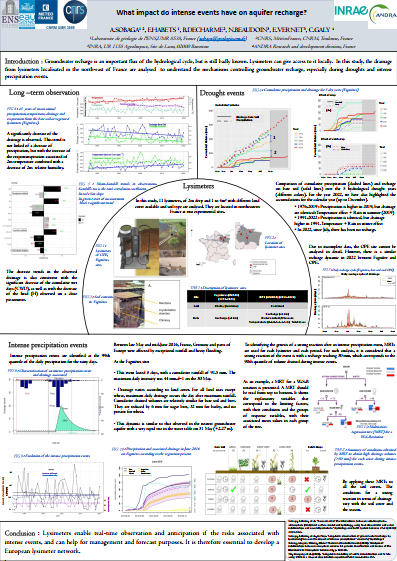
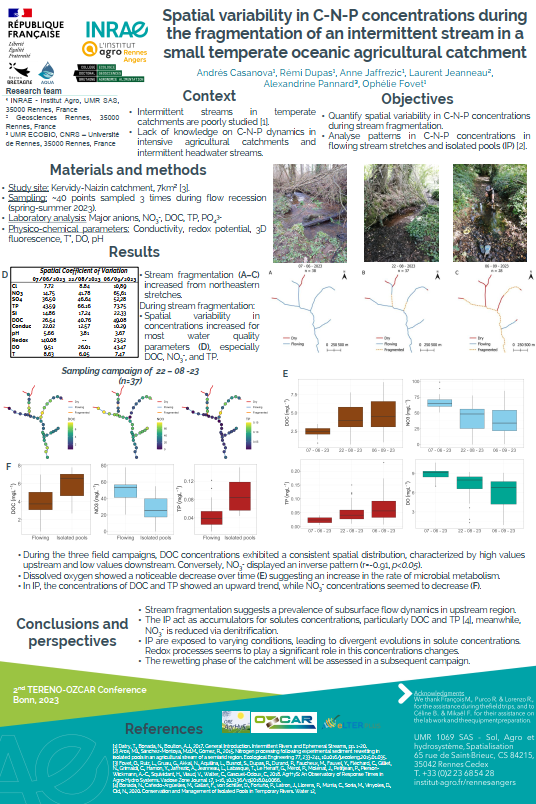
Monitoring large fluctuations of dissolved oxygen in intermittent streams with significant groundwater-surface interactions
Guilherme Emidio Horta Nogueira, UFZ - Helmholtz Centre for Environmental Research GmbH
Combined Effects of Geological Heterogeneity and Discharge Events on Groundwater and Surface Water Mixing
Konstantina KatsanouI, HE Delft Institute for Water Education
Seasonal and spatial variations of physicochemical parameters in headwater catchments to define groundwater input – Wüstebach Catchment, Germany
Thursday Sessions 28.09.2023
Keynotes
Nick van de Giesen, Delft University of Technology
TEMBO Africa: Seven sensors, five products, three services
Frank Hagedorn, Swiss Federal Institute for Forest, Snow and Landscape Research WSL, Birmensdorf
Mountain ecosystems in a changing climate
Anna Balenzano, Consiglio Nazionale delle Ricerche, NaplesEarth
Observation data for high resolution soil moisture monitoring
Philippe Peylin, LSCE, Saint-Aubin
Land surface model parameters optimisation: where we are and new opportunities – Examples with the ORCHIDEE LSM
Francoise Genova, Observatoire de Strasbourg
Science data sharing – feedback from other communities: the case study of astronomy
Session: Biogeochemical processes at the soil and catchment scale
Ralf Kiese, KIT - Karlsruhe Institute of Technology
Impact of climate and management on grassland yields in the pre-alpine region of South Germany
David Gateuille, EDYTEM – CNRS / Université Savoie Mont Blanc
Influence of hydrological regime on soil-to-river pollutant fluxes in alpine areas
Sylvain Kuppel, Géosciences Environnement Toulouse, University of Toulouse, CNRS - IRD - UPS - CNES
Snowmelt and groundwater in mountainous streams and plants: a modeling approach in a snowdominated catchment
Michael Dannenmann, KIT - Karlsruhe Institute of Technology
A review of the importance of mineral nitrogen cycling in the plant-soil-microbe system of permafrost-affected soils – changing the paradigm
Session: Novel methods for the integration and exploration of environmental data
Martin Abbrent, UFZ - Helmholtz Centre for Environmental Research GmbH
Building Scalable Time Series Data Infrastructures: State-of-the-Art Solutions for Accessible and Interoperable Environmental Data
Sylvain Grellet, BRGM, Bureau de Recherches Géologiques et Minières, Orléans
OneWater FAIR Data Platform: setting up a national FAIR water dataplatform and community
Ulrich Loup, Forschungszentrum Jülich GmbH
A General Approach to Unbundle a Largely Monolithic Time-Series Management System
Hervé Squividant, Institut Agro / INRAE - UMR SAS Rennes
SOFAIR - A tool for publishing observation data within an ecosystem of interoperable services
Charly Coussot, Université Grenoble Alpes, IRD, CNRS, Météo-France, INRAE, OSUG
Theia/OZCAR Thesaurus: lessons learned on implementing the I-ADOPT framework, a new Research Data Alliance recommendation designed to facilitate interoperability between scientific variables from different controlled vocabularies
Sami Miaari, Forschungszentrum Jülich GmbH
A machine learning framework to design basin specific drought indexes
Session: Challenges in understanding Critical Zone processes in Africa
Jean-Martial Cohard, Institute of Geosciences and Environment, Univ. Grenoble Alpes, CNRS, IRD
AMMA-CATCH observatory: a portal for regionalizing eco-hydro-climatic observations in West Africa
Jan Bliefernicht, Augsburg University
Current Developments and Challenges in Operating an Environmental Research Observatory in the Sudan Savanna in West Africa – Ten Years of WASCAL
Souleymane Sy, Augsburg University
Land-based mitigation options for climate change in West Africa: Results from WRF-NoahMP-Hydro high-resolution simulations
Chloé Ollivier, HydroSciences Montpellier (HSM), Univ Montpellier
How to adapt critical zone observation strategies to the evolving challenges of the African continent?
Session: Remote sensing for improved analysis of soil-vegetation-atmosphere dynamics at the regional scale
Toni Schmidt, UFZ - Helmholtz Centre for Environmental Research GmbH
Gridded Profile Soil Moisture through Artificial Intelligence
Thomas De Almeida, Univ. Grenoble Alpes, INRAE, CNRS
Mapping vegetation evolution in badlands in response to climate and erosion using aerial and satellite imagery
Nesrine Farhani, HydroSciences Montpellier (HSM), Univ Montpellier, CNRS, IRD
Estimation of evapotranspiration in Sahelian regions from space: review and uncertainty analysis
Thierry Pellarin, Institut des Géosciences de l‘Environnement (IGE)
Use of nadir altimetry data to evaluate a continental hyper-resolution simulation over West Africa
Quentin Beauclaire, TERRA, Gembloux AgroBioTech - Université de Liège
Mechanistic modelling of gross primary production (GPP) and latent heat flux (LE) using sun-induced fluorescence (SIF) observations in different water and light limitation conditions
Session: Model data fusion: Improving model prediction and process understanding
Simon De Cannière, Forschungszentrum Jülich GmbH
Parametrizing a water stress function in a crop growth model using a crop model coupled to a radiative transfer model
Marit Hendrickx, KU Leuven
Impact of Covariance of Soil Moisture Measurements on Inverse Estimation of Soil Water Balance Parameters and on Soil Moisture Predictions
Samira Sadat Soltani, Forschungszentrum Jülich GmbH
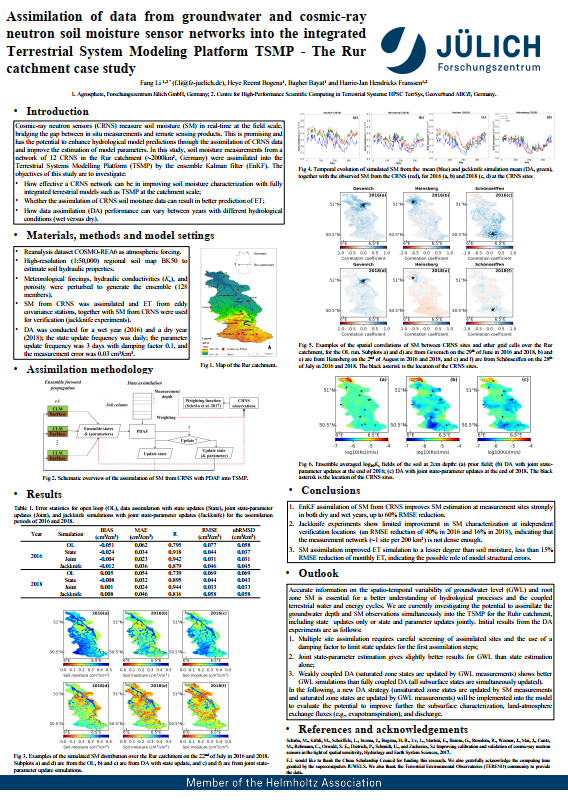
Multivariate data assimilation for improving subsurface storage estimates: A case study of The Upper Rhine Basin
Théo Mazure, INRAE CARRTEL
Coupling soil erosion model and lake sediment records reveals the importance of Alpine erosion crisis in total sediment exports during the Holocene
Marcio Dos Reis Martins, Agroscope
Nitrous oxide emissions and N leaching from permanent grasslands in Western Europe: assessing the impact of management using DayCent
Hao Chen, Tianjin University
A data-driven framework for assembling multiple geoscientific models
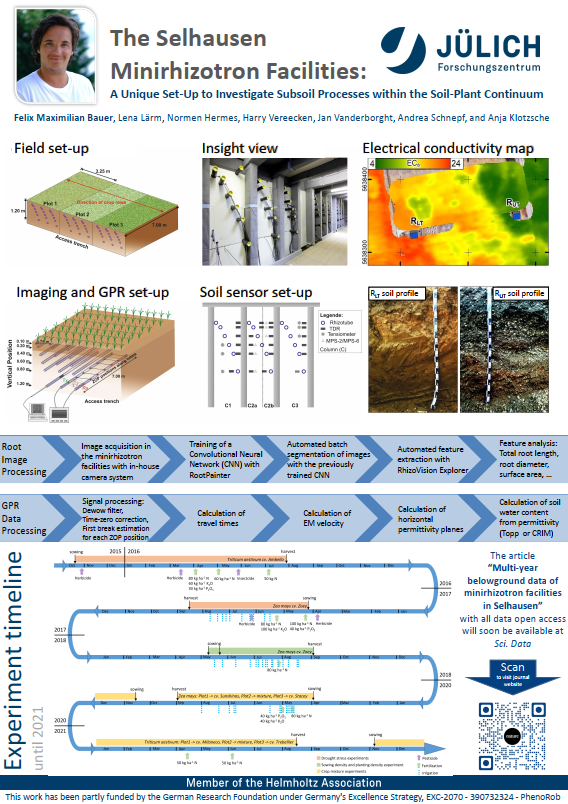
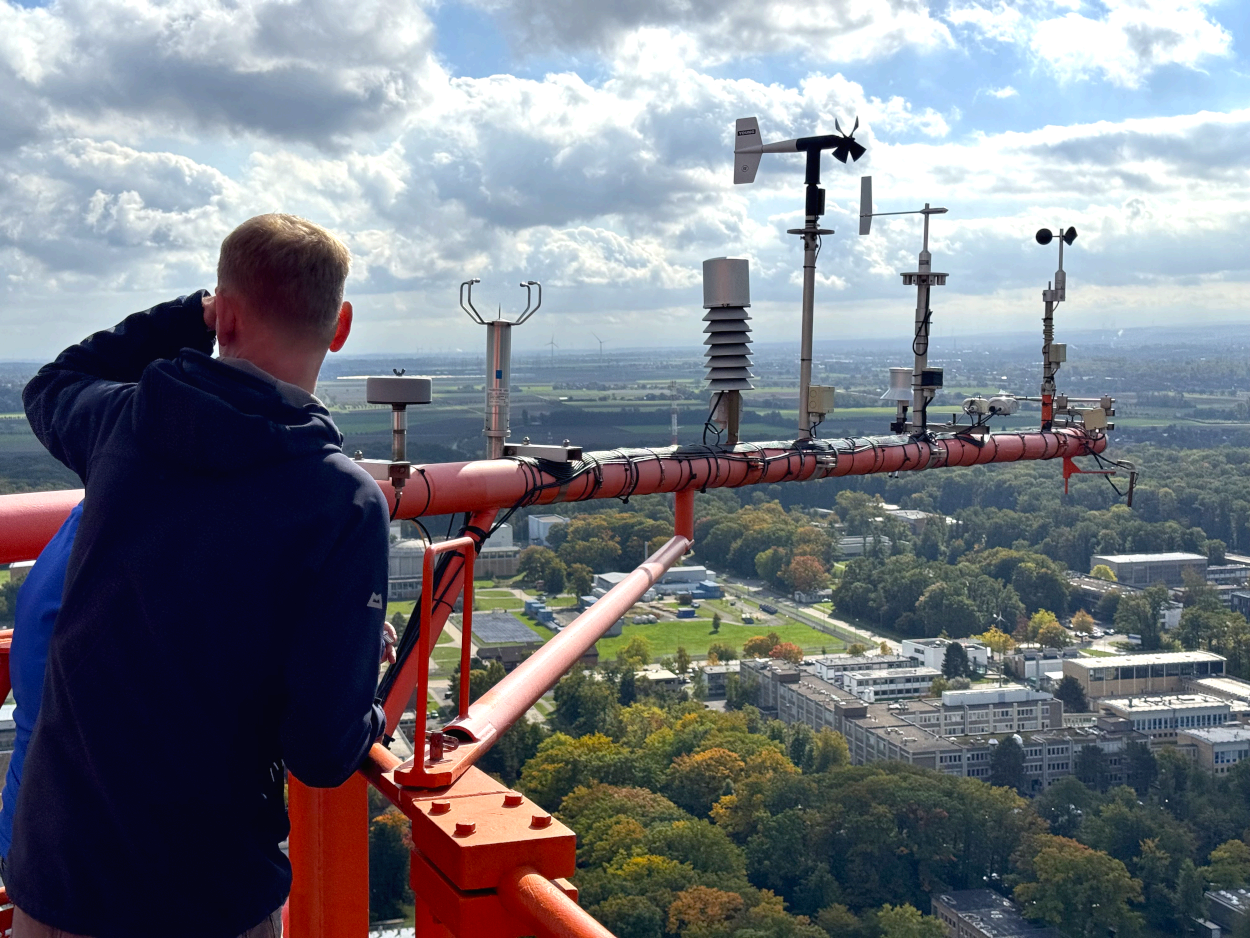 On top of the measurement tower - source: TERENOAs part of the program, attendees visited the TERENO agricultural research site in Selhausen, the TERENO forest site in Wüstebach, and the atmospheric observation station at Forschungszentrum Jülich, operated by the German Weather Service (DWD). A highlight for many was the opportunity to access the top of the 120-meter measurement tower and gain first-hand insights into station operations and measurement technologies.
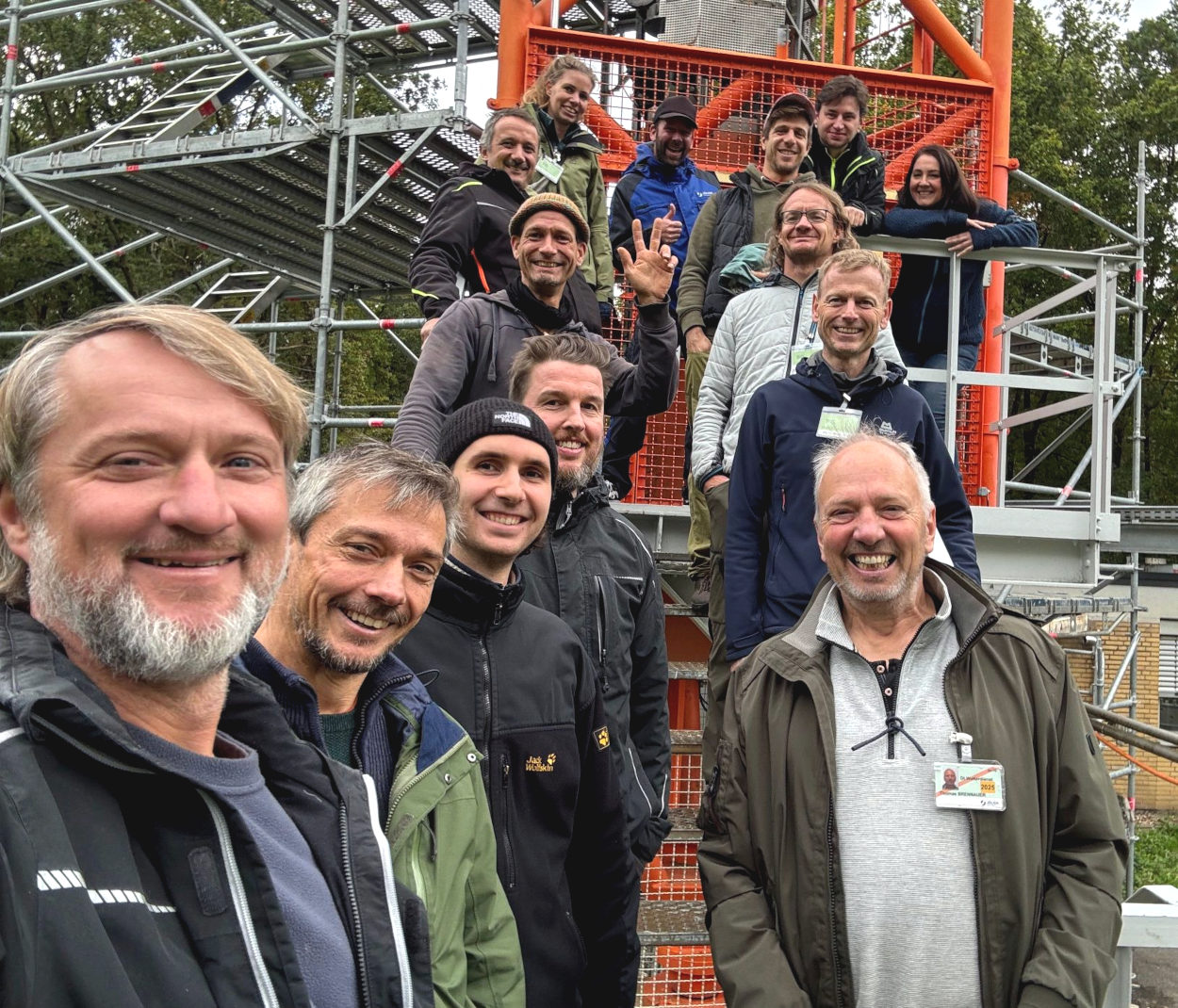 Visiting the measurement tower - source: TERENOTopics discussed this year ranged from implementing eddy covariance and biometeorological sensors to handling vegetation and soil sampling. Participants also exchanged experiences with emerging technologies, including nitrous oxide (N₂O) laser analyzers and advances in high-precision GPS systems that support sensor calibration and field measurements.
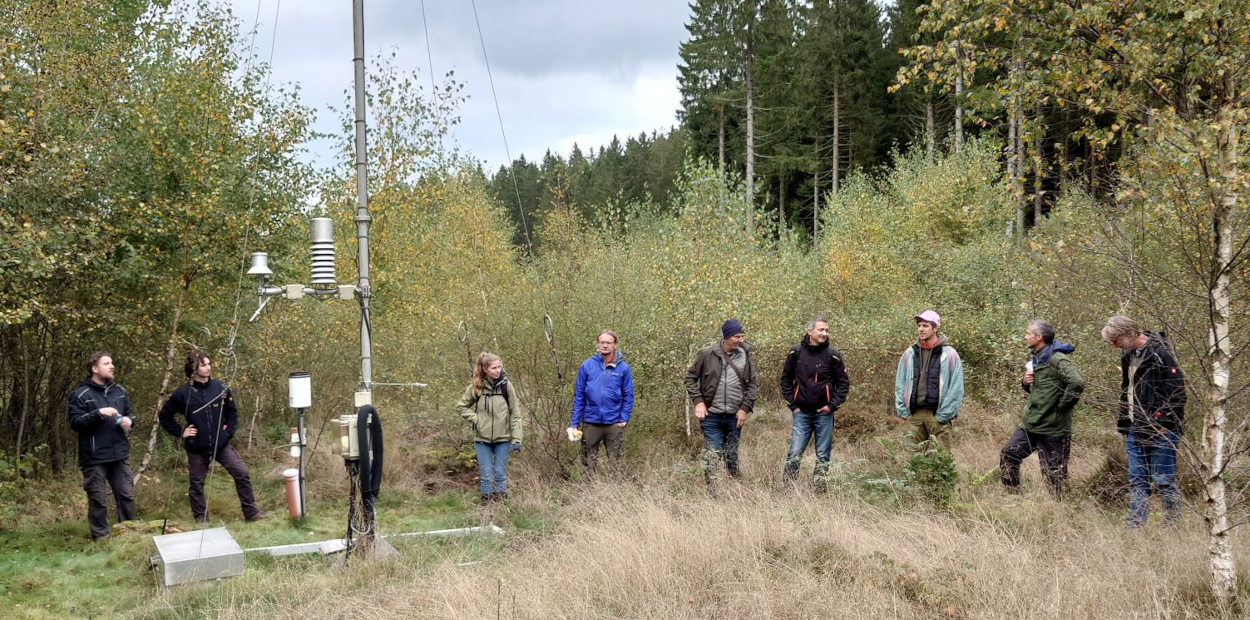 On-site visit - source: TERENO